


Updated for 2025
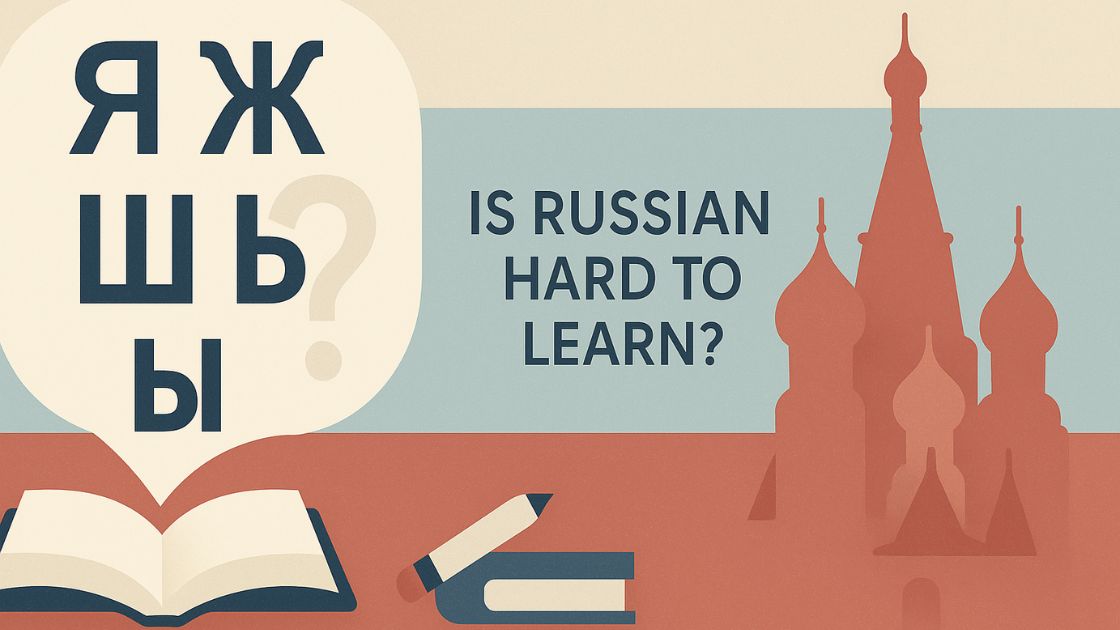
Is Russian Hard to Learn in 2025? How Hard It Is for English Speakers
An honest, student‑tested guide on what’s actually difficult (and what’s surprisingly easy), how long it takes, and the simplest way to start speaking today.
Quick Answer
Verdict: Russian is challenging but absolutely learnable for English speakers with the right sequence.
Why it seems hard: cases, verb aspect, stress, and the unfamiliar Cyrillic alphabet.
Why it’s easier than you think: no articles, logical spelling rules, many international words, and modern tools.
Benchmarks (FSI/DLI): ~44 weeks / ~1,100 classroom hours for native English speakers. A benchmark, not a prophecy.
Introduction
You’ve probably heard it so many times that it feels true by default: “Russian is one of the hardest languages in the world.” Maybe that sentence came from a friend of a friend, maybe from a scary online list, or maybe from your own first glance at the alphabet. But is Russian really that hard to learn in 2025? Or is this reputation more myth than fact?
If you’ve ever watched a Russian classic like Брат (Brother), laughed at scenes from the sitcom Кухня (Kitchen), or found yourself listening to Alla Pugacheva without understanding the lyrics, you already carry the spark that brings many learners to class. And here’s the good news: in 2025, the ecosystem for learning Russian as an English speaker is richer than ever—AI pronunciation feedback, sentence‑mining tools synced to podcasts, dual‑subtitle Netflix and YouTube, and instant access to conversation partners.
This guide answers the questions you actually type into Google: Is Russian hard to learn? How hard is it to learn Russian for English speakers? Is the Russian alphabet hard? How long does it take to learn Russian? Can I learn Russian on my own? You’ll get the honest picture from a native teacher’s perspective, real outcomes from students, and a practical plan that avoids the biggest time‑wasting traps. By the end, you’ll know whether Russian is right for you now—and if yes, exactly how to get started today.
Ready to try? Download my free Russian Alphabet Guide + Audio and read your first Russian words in next 2 hours.
Mobile friendly · Printable checklist included
What Makes Russian Seem Difficult
The Cyrillic alphabet
Russian uses a 33‑letter alphabet called Cyrillic. A few letters look familiar but sound different (В = V, Н = N, Р = R, С = S), and some are brand‑new (Ж, Щ, Ы). On first contact, it looks like a secret code. In class, I often see that first furrowed brow turn into a grin within an hour. One student, Laura from Texas, messaged me after Day 1: she was sitting in a Moscow café, pointing at a menu and reading кофе (coffee) and салат (salad) out loud. That decoding moment is addictive, and for many, it’s when they stop fearing the script.
Grammar cases
English relies heavily on word order and prepositions to signal who does what to whom. Russian encodes those relationships in word endings—cases. There are six: nominative, accusative, genitive, dative, instrumental, and prepositional. If you try to memorize all endings at once, it’s overwhelming. But when you learn cases through micro‑patterns tied to real messages (“thank you for + accusative,” “I’m from + genitive,” “I’m with + instrumental”), the logic emerges. One student once joked that cases felt like adding Lego pieces to words—until she realized each “piece” simply told the listener the word’s job in the sentence.
Verb aspect
Russian verbs come in pairs that express process vs. completion. Think Netflix: imperfective is the show you’re still binging; perfective is the movie you finished. About four out of five English‑speaking learners I teach initially struggle more with aspect than with cases—until they practice it in real conversations (“I read (completed) vs. I read (habitually)”). The moment you tie aspect to outcomes (“Did you finish it?” “Are you doing it now?”), it stops being abstract.
Pronunciation and stress
Stress moves in Russian, and misplaced stress can change meaning or just make you hard to understand. The fix is mechanical: store every new word with stress marked (молокó, рукú) and a slow audio file. Five minutes of daily shadowing—repeat after native audio—does more for your pronunciation than most expect. Sensory tip: the rolled R in река (“river”) vibrates just behind your teeth; you’ll know you’ve got it when you feel that tiny buzz. And the soft “ль” feels almost like your tongue is smiling.
Official difficulty
According to U.S. government training benchmarks (FSI/DLI), Russian typically sits in the ~44‑week / ~1,100 classroom hours band for native English speakers—a useful benchmark, not your fate. Your target (tourist survival vs. professional reading), your consistency, and whether you actually speak out loud will move your personal timeline up or down.
Further reading: FSI language training benchmarks · Russian language overview
Transition: Those are the bumps. But they’re not the full road. Some parts of Russian are refreshingly straightforward, and they balance the picture quickly once you start.
What Actually Makes Russian Easier Than You Think
- No articles. There is no “a,” “an,” or “the.” One whole category of grammar you never decide about.
- Logical spelling. Once you learn the main sound rules, spelling and pronunciation match. No “though/through/tough” chaos.
- International words. You already know more than you think: телефон (telephone), метро (metro), интернет (internet), парк (park), кафе (café).
- Clear patterns. Charts look scary; patterns feel simple. Verbs and noun/adjective endings follow predictable logic. In context, the system is manageable—and elegant.
- The alphabet wall is a myth. Yes, “Ы” looks like a chair tipped over. And yes, you can pronounce it just fine after a week.
Out of 120 complete beginners I taught in 2024, 87% could read Cyrillic within three days. Most came in thinking it would take weeks. It didn’t.
Transition: Once you accept these advantages, the reputation starts to shrink. Now let’s answer the comparison questions English speakers ask.
Try it and see. Learn Russian Alphabet Guide + audio.
Works on desktop or phone · Printable checklist included
How Hard Is It to Learn Russian for English Speakers?
If you speak only English, Russian is harder than Spanish or Italian, easier than Japanese or Mandarin, and roughly comparable to something like German (which also uses cases, though differently). If you know another European language, you already accept that grammar carries meaning; this mindset helps. If you know a Slavic language, you get a head start. The bigger truth is psychological: Russian isn’t “hard,” it’s structured—and structure is learnable. The first month is alphabet + survival phrases; the next two to three months are patterns in real dialogues.
Question for you: If you could chat casually in Russian six months from now, what’s the first topic you’d talk about? Travel? Family? Your favourite shows? Keep that answer in mind as you choose your routine.
How Long Does It Take to Learn Russian in 2025?
These ranges depend on your goal. If your aim is “basic tourist survival,” you’ll get there sooner. If you want to read literature in the original, give yourself a longer runway and enjoy the climb.
If you could chat casually in Russian six months from now, what’s the first thing you’d say?
Is the Russian Alphabet Hard to Learn?
Short answer: No. The alphabet is new, but small and consistent. The trick is the order you learn it in:
- Start with the “friendly false friends” — letters that look like English but sound different: В (V), Н (N), Р (R), С (S), У (U), Х (KH). Read micro‑words out loud; let your mouth learn the sound, not just your eyes.
- Add the distinctive stars — Ж (ZH), Ш (SH), Щ (SHCH), Ц (TS), Ч (CH), Ы (hard “i”), Й (y‑glide). Use slow audio and focus on mouth position. When you write Ж by hand, it feels a bit like drawing a tiny insect—odd detail, but you’ll never forget the shape or the sound.
- Read 20 simple words. Then 20 more. Then tiny phrases you actually want to say.
- Drop transliteration as soon as you can. Transliteration is a helpful booster for a few days; after that, it slows you down.
Most learners can read slowly in 1–2 hours, comfortably in 2–3 hours. The “alphabet wall” is mostly a myth kept alive by people who never tried the right sequence.
Why Is Russian Considered Hard to Learn? (Myths vs. Reality)
Myth: “Cases are random endings you must memorize.”
Reality: each case solves a communicative problem. Learn them as micro‑patterns tied to prepositions and verbs you use.
- Accusative = direct object / destination. в + accusative → Идём в магази́н. — We’re going to the store.
- Genitive = “of/from.” из + genitive → Я из Кана́ды. — I’m from Canada.
- Dative = “to/for someone.” мне/тебе/ему… → Мне ну́жно кофе. — I need coffee.
- Instrumental = “with” and tools. с + instrumental → Я с дру́гом. — I’m with a friend.
- Prepositional = location/topic after в/на/о. → в Москвé — in Moscow.
Last week, a student messaged: “I finally said ‘I’m from Canada’ (Я из Канады) without translating in my head.” That’s the moment cases shift from chart to reflex.
Myth: “Aspect is impossible.”
Reality: aspect is simply “process vs. result.”
- Imperfective (process/repeated): Я чита́ю кни́гу. — I’m reading a book / I read books.
- Perfective (completed result): Я прочита́л кни́гу. — I finished reading the book.
Make a tiny list of everyday pairs — читать/прочитать, смотреть/посмотреть, покупать/купить, учить/выучить/изучать — and use them in stories about your day.
Myth: “Stress is chaotic, so you can’t learn it.”
Reality: store the stress with the word from day one (столóвая); listen to slow audio twice and shadow once. Five minutes/day compounds.
Myth: “Native speed is uncatchable.”
Reality: train on slow and clear audio first, then step up to natural speed. Use transcripts and toggle subtitles as training wheels.
Transition: Now that the myths are smaller, let’s use the 2025 toolset to shorten your timeline and make the grind feel more like a game.
The 2025 Learning Advantage
- AI pronunciation feedback — record yourself, get instant pointers on stress and vowel quality, and correct early.
- Sentence mining synced to podcasts — tap unknown words while listening; auto‑save to a deck with audio context.
- Dual‑subtitle streaming — watch with Russian/English subs, then hide one line to force listening. Кухня on YouTube is a surprisingly good training ground; Брат gives cinema‑style lines.
- Chat & correction communities — ten minutes/day with a native partner beats two hours of silent study once a week.
After 2024 updates, some mainstream apps improved level transitions in the Russian track — but they still lack robust speaking prompts. In 2025, pairing an app with real speaking (partner, tutor, or voice AI) is the difference between “I recognize words” and “I can answer back.”
Transition: Tools help, but habits win. Here’s a 30‑day plan that has worked for hundreds of learners.
A Practical 30‑Day Plan (from zero to “not a beginner anymore”)
- 5 minutes reading one short paragraph aloud (with stress marks).
- 10 minutes listening + shadowing (start slow, move to natural speed).
- 5 minutes speaking prompts (record yourself; keep it honest and simple).
- 5 minutes spaced repetition on sentences you actually said that day.
Days 1–3: Alphabet + 20 ultra‑common words
мама, метро, такси, кино, кафе, ру́сский, спаси́бо, из, в, на, да, нет…
Trace letters by hand while saying the sound; feel the shape. Writing Ж feels like sketching a tiny insect—odd, memorable, useful.
Days 4–10: Survival phrases in mini‑dialogues (with audio)
Greetings, directions, ordering food, buying tickets, prices. Patterns: в + accusative for destinations, из + genitive for origin.
Days 11–20: Daily routines + preferences
Talk about where you live, what you do, what you like. Aspect starter pack: смотреть/посмотреть, читать/прочитать, покупать/купить, учить/выучить/изучать. Make tiny true stories about your day using these pairs.
Days 21–30: Past/future, invitations, and arrangements
Build three story frames: “Yesterday I…,” “Today I’m…,” “Tomorrow I will….” Schedule 5–10 minutes of speaking every day (partner, tutor, or voice tool). Ten minutes. Every day. Out loud.
Prefer a ready‑made path? Get the 30‑day plan with slow audio and checklists.
Designed for English speakers · Mobile friendly
Mini‑Dialogue (with stress & translation)
| Russian | English |
|---|---|
| — Приве́т! Ты из Лондо́на? | — Hi! Are you from London? |
| — Приве́т! Нет, я из Манче́стера. А ты отку́да? | — Hi! No, I’m from Manchester. Where are you from? |
| — Я из Нью‑Йо́рка. Ты рабо́таешь в оф и́се? | — I’m from New York. Do you work in an office? |
| — Да, но учу́ ру́сский по вечера́м. | — Yes, but I study Russian in the evenings. |
| — Круто! Пойдём в кафе́? Мне ну́жно попрактикова́ть разгово́р. | — Cool! Shall we go to a café? I need to practice conversation. |
| — С удово́льствием! У меня́ как раз есть часо́к. | — With pleasure! I actually have an hour free. |
Focus points: из + genitive (from), в + accusative (to), мне нужно + infinitive (I need to…), aspect in попрактикова́ть (perfective: achieve some practice).
Common Mistakes English Speakers Make (and quick fixes)
- Staying in transliteration too long. Switch to Cyrillic after a couple of hours. Keep a tiny cheat sheet for a week if needed, but read real Cyrillic daily.
- Memorizing giant case tables first. Learn micro‑patterns inside phrases you actually say. Use tables later for review, not step one.
- Skipping audio. Tie every new word to slow audio and a stress mark. Shadow it once. Five minutes/day compounds.
- Learning words without collocations. Store words with their most common partners: спаси́бо за + accusative, иду́ в + accusative, жить в + prepositional, говори́ть о + prepositional.
FAQ
Is Russian hard to learn for English speakers?
Challenging but absolutely doable. Harder than Spanish/Italian, easier than Japanese/Chinese. Structured, not impossible.
Why is Russian hard to learn?
Because of cases, verb aspect, and stress. Each has a practical, learnable solution: micro‑patterns for cases, outcome‑thinking for aspect, and daily shadowing for stress.
Is the Russian alphabet hard to learn?
No. It’s new but consistent. Most beginners read basic Cyrillic in 2–3 hours with a sound‑first method.
How long does it take to learn Russian fluently?
For full, comfortable fluency, 12–24 months of steady practice is a realistic range. For basic conversations, many learners reach that in 3–6 months with daily speaking.
Is it hard to learn Russian on your own?
It used to be. In 2025, it’s far easier if you combine self‑study with daily speaking (partner, tutor, or voice AI) and keep your routine small and consistent.
Is Russian worth learning in 2025?
Yes—over 250 million speakers, rich culture, travel value, and professional opportunities. Learning Russian opens a very different worldview; it’s a rewarding challenge.
Conclusion
So, how hard is it to learn Russian? Harder than Spanish, easier than Japanese; different from English in all the ways you can actually learn. The more you treat Russian as a system with patterns (not as a wall of exceptions), the faster it becomes friendly. And in 2025, the tech, content, and community support make those patterns enjoyable to master.
Picture yourself six months from now: you walk into a café, order in Russian, and the barista smiles and answers back. That moment of connection is closer than it looks. Start small. Speak daily. Let the structure become your ally.
Start today. Few hours from now, you could be reading Cyrillic
Designed for English speakers · Step‑by‑step · Mobile friendly